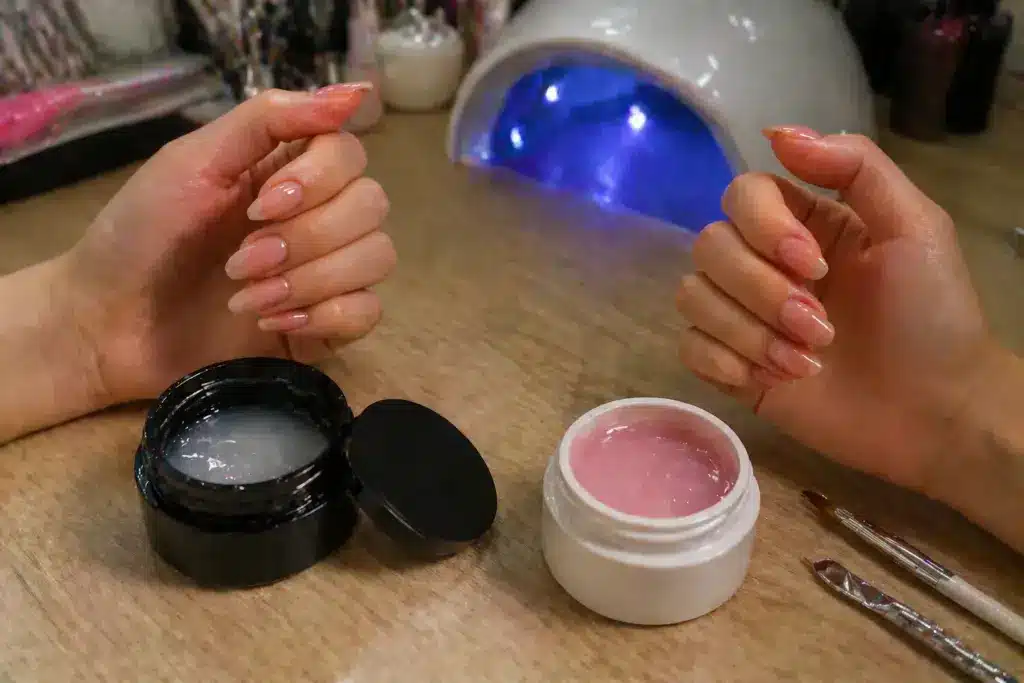

Two gel products sitting on the shelf, both used for building nails, both cured under a lamp, yet they behave completely differently once they are on your fingers.
The confusion around hard gel vs builder gel is not just common among beginners. Even regular salon clients often have no idea which one is on their nails. The difference between them is not just a matter of technical terminology.
It determines how long your nails last, how they feel, how they come off, and whether you leave the salon with healthy nails underneath.
Here is a clear breakdown of what sets them apart, how each one performs, and which one is the right fit for your nails.
What Is Hard Gel?
Hard gel is a nail enhancement product that cures under an LED or UV lamp to form a rigid, non-porous layer on the nail.
Once cured, it cannot be dissolved with acetone, and that single property shapes everything about how it performs and who it suits. It is non-porous, which is precisely why it cannot be soaked off.
Applied with a separate brush from a pot, the thick viscosity and low self-leveling properties mean it requires real skill to shape cleanly before curing. Since it resists acetone completely, the only removal method is professional filing; there is no shortcut.
What Is Builder Gel?
Builder gel is a UV or LED-cured gel used to add volume, structure, and strength to natural nails. Unlike hard gel, it is designed to work with the nail rather than over it, which changes how it feels, how long it lasts, and how it comes off.
It comes in soft, semi-hard, and hard varieties, with each type determining how much length it can add and how it is removed.
The finish is more satin-like and natural-looking than hard gel, making it the go-to choice for anyone who wants strength without the rigidity that hard gel brings.
Hard Gel vs Builder Gel: What Sets Them Apart
Most gel nail problems stem from improper use, not the product. Switching between hard gel and builder gel without understanding their differences often causes issues.
The main mistake is treating both the same, even though they work very differently. Here’s where those differences matter most.
1. Removal Method

Hard Gel cannot be dissolved with acetone under any circumstances. The only removal method is professional filing, which requires skill to avoid thinning the natural nail.
Nail professionals consistently warn that forcing removal without understanding the product can lead to long-term damage.
Builder Gel (most soak-off formulas) dissolves with acetone, making removal manageable at home between appointments. However, not all builder gels soak off the label, which is the only reliable guide. If it says “file-off,” treat it like hard gel, regardless of the name.
2. Flexibility

Hard Gel cures into a rigid, inflexible layer that does not move with the natural nail. That firmness makes it ideal for long extensions; it holds its shape under pressure without bending.
Builder Gel remains flexible to semi-rigid after curing, giving the nail a feel closer to natural movement. That flex reduces the risk of snapping under sharp impacts, making it a more practical choice for everyday use.
3. Viscosity and Self-Leveling

Hard Gel has a thick consistency with low self-leveling. It stays exactly where it is placed, so shaping must occur before the product is cured. This demands a more practiced hand during application.
Builder Gel has a medium viscosity and levels out more readily on its own. Less manual shaping is needed to get an even surface, which is a significant advantage for beginners or those working without a nail form.
4. Wear Time

Hard Gel lasts 3 or more weeks and does not grow out the way softer products do. Because it cannot be soaked off, it stays on until professionally filed away, making wear time less of a variable and more of a commitment.
Builder Gel typically lasts 2 to 3 weeks, depending on the formula, nail prep, and daily activity. The flexibility that makes it comfortable also means it may not hold as long under heavy or repeated stress.
5. Skill Level Required

Hard Gel requires a higher level of technical skill. The thick consistency does not correct itself, and any unevenness in the application stays visible after curing. Application mistakes cannot easily be undone without going back.
Builder Gel is considerably more beginner-friendly. The self-leveling quality and softer consistency make small placement errors more forgiving. It is the product most commonly recommended for those learning gel application at home.
When to Choose One Over the Other?
Choosing between the two becomes easier when you compare your priorities side by side. This quick table helps you match your needs with the right option for the moment:
When to Choose Hard Gel
- Regular salon appointments where a structured, long-lasting result is the priority every time.
- Building nail extensions that need to hold their shape firmly for several weeks without lifting.
- Creating detailed nail art that requires a strong, stable base to layer designs on top of.
- Heavy daily wear where a high-shine, glossy finish needs to stay polished and intact.
When to Choose Builder Gel
- Doing your own nails at home without professional training or advanced application experience.
- Preferring a lightweight feel that moves naturally and does not make nails feel heavy or stiff.
- Wanting a softer, more natural-looking finish without any added bulk or structured layers.
- Low-maintenance routines where quick, simple touch-ups between applications matter most.
When you focus on how you apply, wear, and maintain your nails, the right choice becomes clear. Pick the option that fits your routine, not just the result you want.
What Is Hard Builder Gel?
Some brands sell a product called hard builder gel, which is where the builder gel vs hard gel line gets genuinely blurry.
The name includes “builder,” but the removal method is file-off, not soak-off. Here is how to tell what you actually have:
| The Label Says | What It Means | How to Remove |
| Soak-off | Soft builder gel | Acetone |
| File-off | Hard gel (regardless of name) | Professional filing only |
| Hard builder gel | Hard gel formula for building | Professional filing only |
| Semi-hard gel | Falls between the two | Check manufacturer instructions |
Users flagged this exact confusion builder gel can be hard or soft, but hard gel by definition cannot be soaked off with acetone.
The label is the only reliable guide. If it says file-off, treat it like hard gel regardless of what else the name implies.
Common Mistakes With Both Gel Types
Most problems with gel nails are not about the product; they are about the decisions made before and during application. Switching between hard gel and builder gel without understanding how differently they behave is where things tend to go wrong.
- Name vs label: “Builder gel” does not mean soak-off. Check the removal method before buying
- Compatibility: Not all formulas work together. Mixing brands without checking leads to lifting
- Removal mix-up: Hard gel needs filing. Soak-off builder gel needs acetone. Using the wrong method damages nails
- Copying results: What works on one nail type may not work on another. Oil levels and thickness vary
- No test nail: Always test a new formula on one nail before committing to a full set
Closing Thoughts
The single most useful thing to take away from the hard gel vs builder gel conversation is this: hard gel stays rigid, lasts until it grows out, and must be filed off by a professional.
Most builder gels are flexible, soak-off products that work for overlays and natural nail support. Neither product is better across the board.
The right one is the one that fits your nail goals, your lifestyle, and how often you realistically plan to see a nail technician. Before buying anything, check whether the formula is soak-off or file-off. That one label tells you most of what you need to know.
Have you tried hard gel, builder gel, or both? Drop a comment below which one worked for you, and what made the difference.
Frequently Asked Questions
Can hard gel and builder gel be used together?
Yes. Layer the builder gel as a flexible base, then top it with hard gel for durability. Professional technique only. This layering takes advantage of the flexibility of builder gel at the base and the rigidity of hard gel at the surface.
Is BIAB the same as builder gel?
BIAB is a branded brush-on format of builder gel. Same product category, different packaging, most formulas are soak-off.
Can you paint over hard gel without removing it?
Yes. Gel polish applies directly over hard gel and removes with acetone without disturbing the hard gel underneath.
Does hard gel damage nails?
Not when removed correctly by a professional. The risk is incorrect filing during removal, which thins the natural nail.
Which is cheaper long term?
Builder gel. Soak-off removal can be done at home, removing the cost of a professional removal appointment each cycle.